Freeze the board at the right moment so fast-moving classroom content is not lost while the lesson continues.
 Accessible classroom vision support
Solution
Turn distant whiteboards into clear learning support.
Lumen helps students with low vision capture classroom boards, reconstruct the content into something more readable, and understand what happened through guided explanations instead of relying only on fast verbal cues.
Turn faint, distant, or messy writing into a cleaner board view that is easier to read and revisit calmly.
Pair each board with guided explanation and saved class history so understanding does not depend on memory alone.
What it changes
Stay with the classroom, learn faster and smarter.
The solution is not just about taking a picture. It is about capturing the right moment, making the board easier to read, and helping a student understand and revisit what was taught.
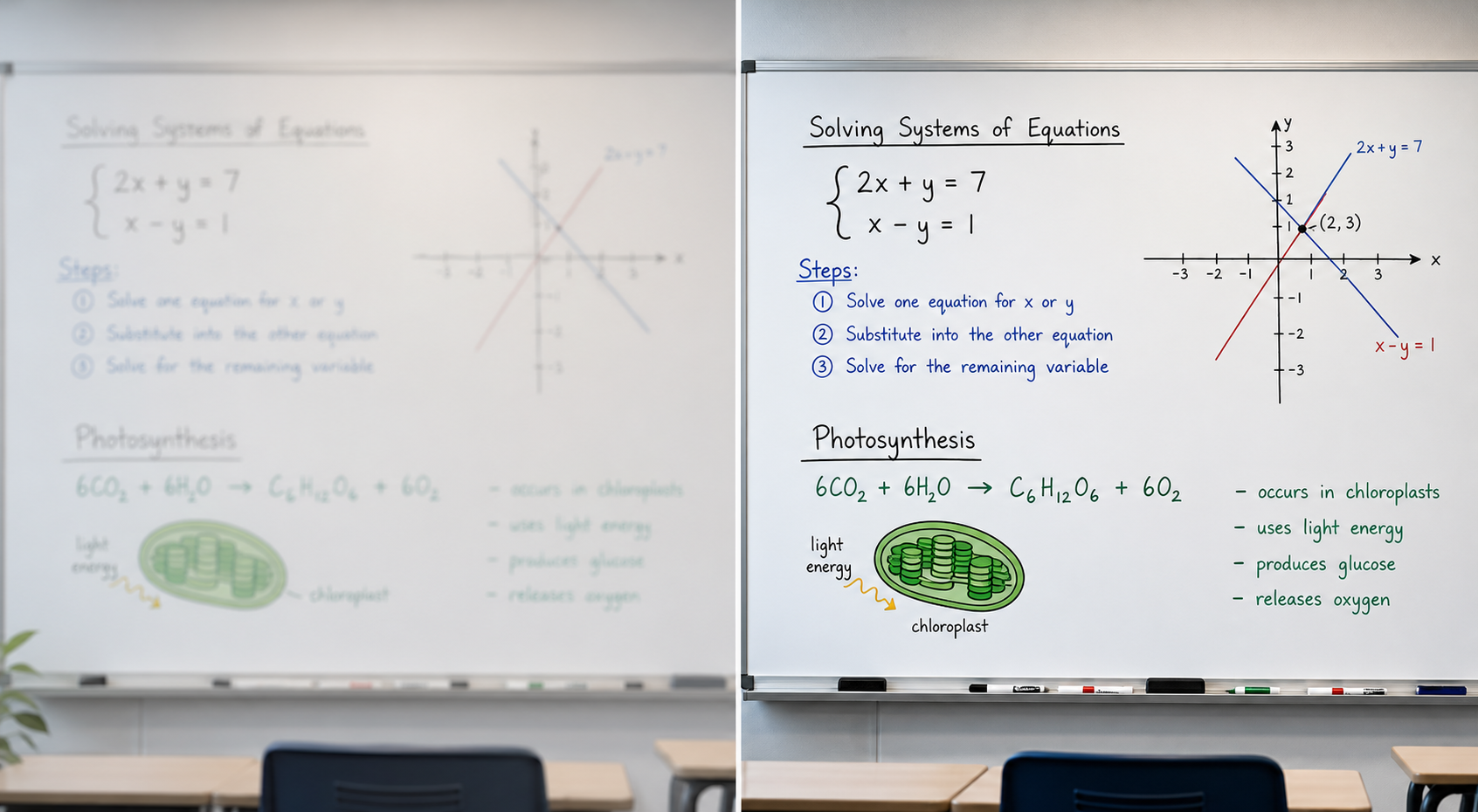
From difficult-to-read to far more usable
This comparison shows the heart of the solution: a distant classroom board may appear soft, faint, or fuzzy to a student with albinism, while Lumen works to reconstruct it into something cleaner and easier to study.
Before
Blur, weak contrast, and board content that is easy to miss while the lesson keeps moving.
After
A clearer structure that makes equations, notes, and diagrams much easier to revisit and understand.

Built for the exact classroom scene
The classroom image reflects the real environment where Lumen matters most: students seated at a distance while the board changes quickly in front of them.
Why this belongs under solution
These visuals explain both the challenge and the product value in one place, so visitors immediately understand what Lumen does and why it matters.
Instead of a separate decorative section, they now strengthen the core solution story directly.
How it works
A simple path from board to understanding.
The experience is designed to stay focused on the moment a student needs help most: while the board is still active, the lesson is moving forward, and clarity has to happen quickly without adding friction.
Capture
Capture the board at the right moment, before details disappear or get replaced by the next part of the lesson.
Rebuild
Reconstruct the board into a cleaner digital view that reduces visual noise and makes the written structure easier to follow.
Explain
Turn the visual content into guided explanation so the student understands not just what was written, but what it means.
Review
Return to saved sessions later through personal history, so revision depends less on memory and more on accessible records.
Founder story
Built by Rishabh Patni, for the classroom he knows firsthand.
A founder story shaped by lived classroom experience, practical constraints, and the decision to build a better answer instead of waiting for one.
From daily classroom difficulty to a working solution.
Rishabh Patni is a Grade 9 student living with albinism and low vision. Over the years, and especially as academic pressure increased in the higher grades, he often found it difficult to clearly grasp what was happening on the classroom board in real time.
Even with helpful schools and supportive teachers, there were still moments when the lesson moved faster than accessibility could keep up. Like many students with low vision, he often had to depend heavily on spoken cues and memory, even when the most important information was visual.
That challenge pushed him to start exploring what kinds of tools already existed. He discovered that some devices and solutions were available elsewhere, but many of them were far too expensive to be practical.
So he asked a different question: what if he built one himself? That question turned into Lumen, a live working app shaped by the real problems he faces in class and by a clear understanding of what would genuinely make learning easier.
Why this matters
Because Lumen is built by someone with low vision, it is grounded not just in technical possibility, but in firsthand understanding of what the classroom challenge actually feels like and what needs solving most.
In his own words
Hear from the founder
Rishabh shares the classroom experience that inspired Lumen and the difference he hopes it can make for students.
Founder message coming soon
A personal introduction to Lumen from Rishabh Patni.